


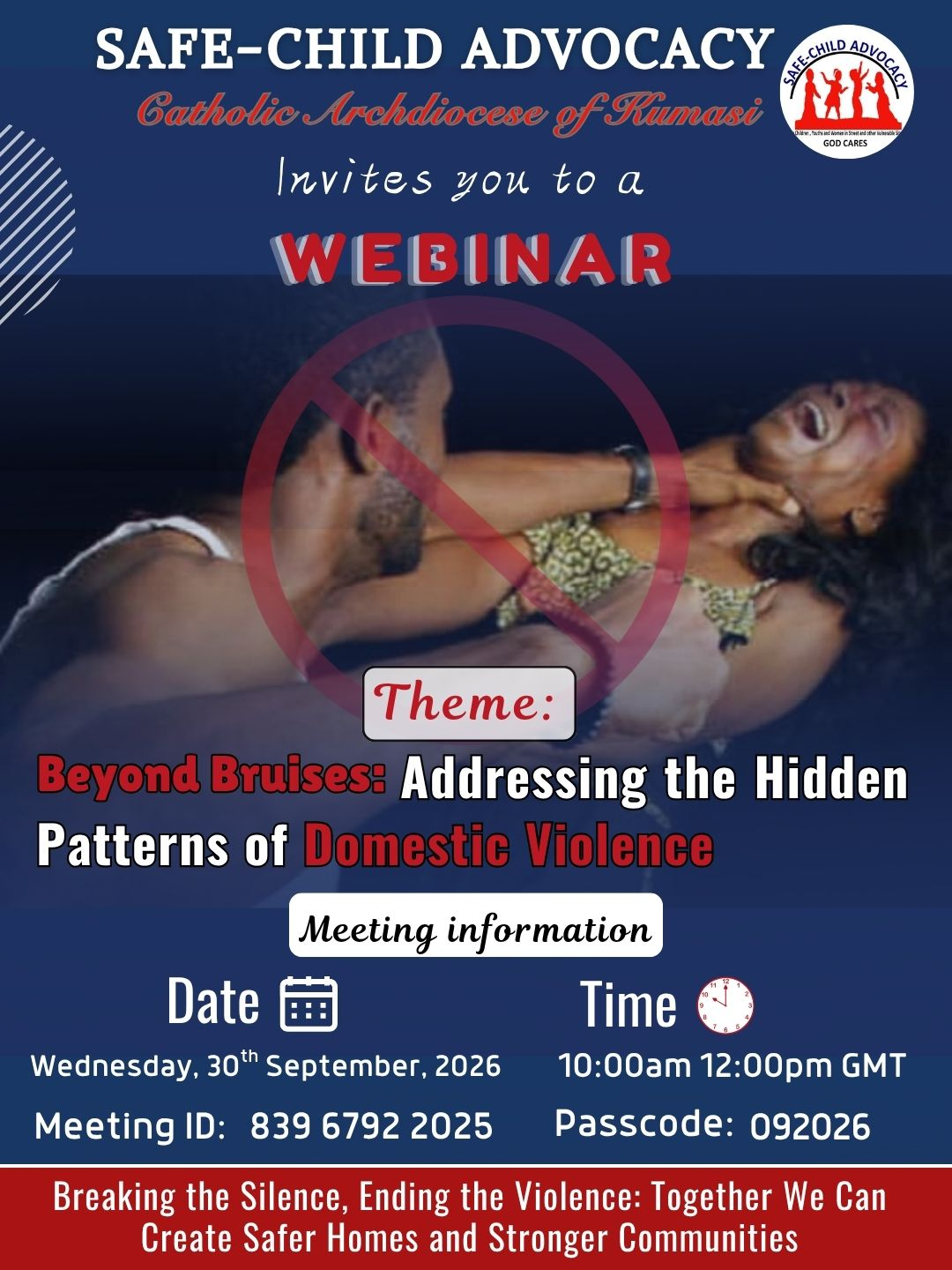
 Safe-Child Advocacy (SCA) has successfully held our Third Quarter Webinar under the theme, “Beyond Bruises: Addressing the Hidden Patterns of Domestic Violence” on Wednesday, 30th September, 2026. The session brought together advocates, professionals, duty bearers, partners and members of the public to reflect on the less visible forms of abuse that affect children, individuals and families.
The webinar reminded participants that domestic violence goes beyond physical injuries. It can also take the form of emotional manipulation, psychological intimidation, coercive control, economic deprivation, social isolation, threats and other harmful behaviours that may leave deep scars even when they are not easily seen.
During the opening remarks, Rev. Sr. Olivia Umoh, DC, Director of Safe-Child Advocacy, noted that some of the most painful effects of domestic violence are the ones people do not always notice. She encouraged participants to pay attention to warning signs, support survivors, challenge harmful social norms and help build safer homes and communities.
Superintendent Immaculate Obidiaba of the Ghana Police Service, DOVVSU Unit, highlighted the important role duty bearers play in protecting victims of domestic violence. She explained that police officers receive complaints, help ensure the immediate safety of victims, preserve evidence, investigate cases and refer survivors to the right support services.
According to Supt. Obidiaba, the Domestic Violence and Victim Support Unit (DOVVSU) is mandated to prevent abuse, protect victims, and enforce laws on domestic violence. She also acknowledged that their work can be difficult when family members or influential community figures interfere in cases and discourage victims from seeking justice.
She stressed that a victim’s relationship with an alleged offender, whether as a spouse, relative, or family member, does not stop the police from investigating abuse. She added that depending on the case, the Police may work with the Attorney-General’s Department, the Department of Social Welfare and other relevant institutions to secure support and justice for survivors.
As a panel member, Rev. Paul Akwasi Amankwaah, Counsellor at Kumasi Technical University in Kumasi spoke about the sociocultural barriers that prevent many victims from seeking help. He explained that some families hide incidents of domestic violence to protect their reputation and preserve family dignity, creating a culture of silence that allows abuse to thrive.
Rev. Amankwaah further explained that certain cultural norms and gender expectations push some victims, especially women, to endure abuse in silence. He pointed to rigid interpretations of marriage vows such as “for better, for worse,” fear of divorce-related stigma and pressure from extended family members as some of the reasons people remain in abusive relationships.
He described abuse as the misuse of power by one person to harm another. He emphasized that ending domestic violence requires everyone to challenge harmful beliefs and promote respect, dignity and equality in relationships.
The webinar also drew attention to how domestic violence affects children. Participants were reminded that even when children are not directly abused, witnessing violence at home can affect their emotional well-being, education, development, protection and right to grow up in a safe and nurturing family environment.
At the end of the session, Safe-Child Advocacy called on families, communities, faith leaders, traditional authorities, law enforcement agencies, social welfare officers, educators, health professionals, civil society organizations and individuals to work together to prevent domestic violence and support survivors.
Domestic violence is not always visible. Recognising its hidden patterns is an important step toward protecting survivors, safeguarding children, and building peaceful communities where everyone can live with dignity and security.


